TABLE OF CONTENTS
- About Book…………………………………………………….
- About The Editors…………………………………………………
- Table of Contents……………………………………………………
- Preface and Acknowledgments……………………………………………………………
- List of Cases……………………………………………………….
- List of Statutes……………………………………………………
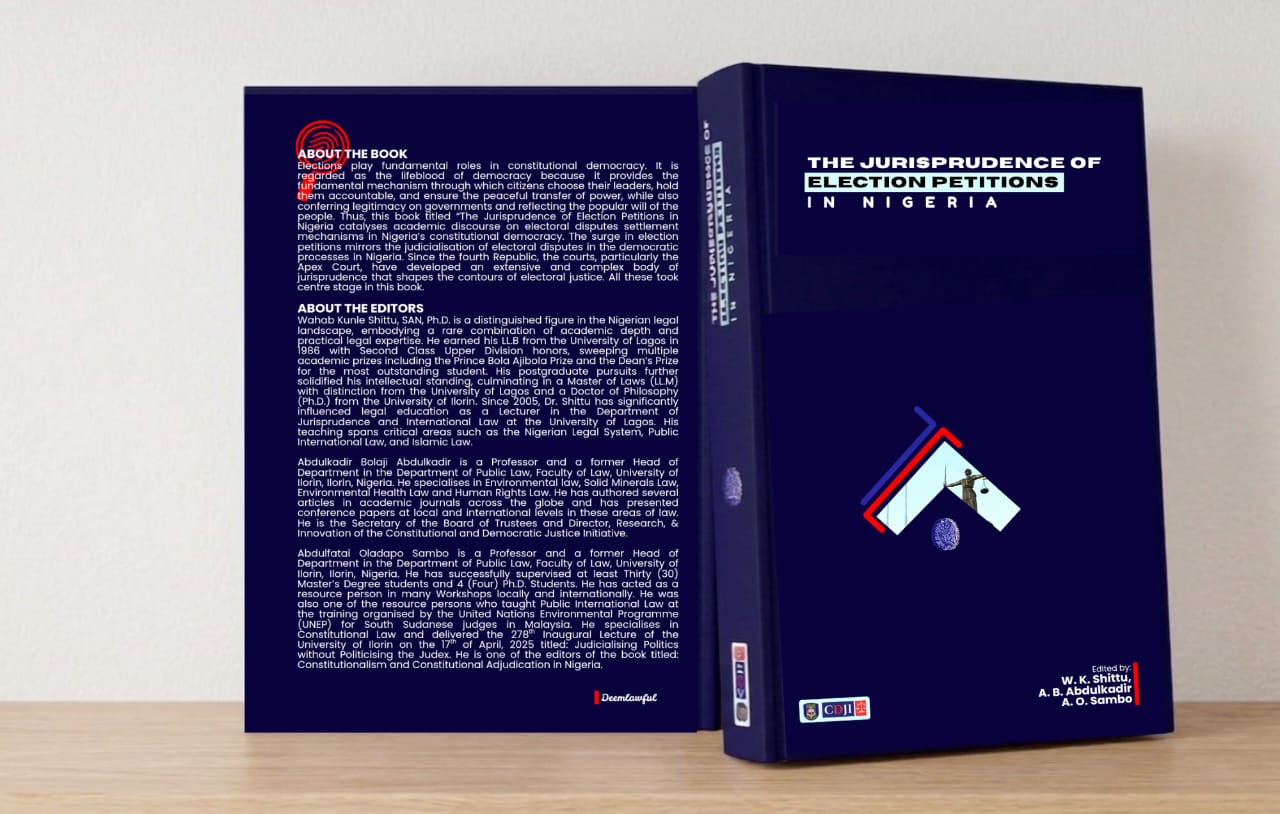
ABOUT THE BOOK
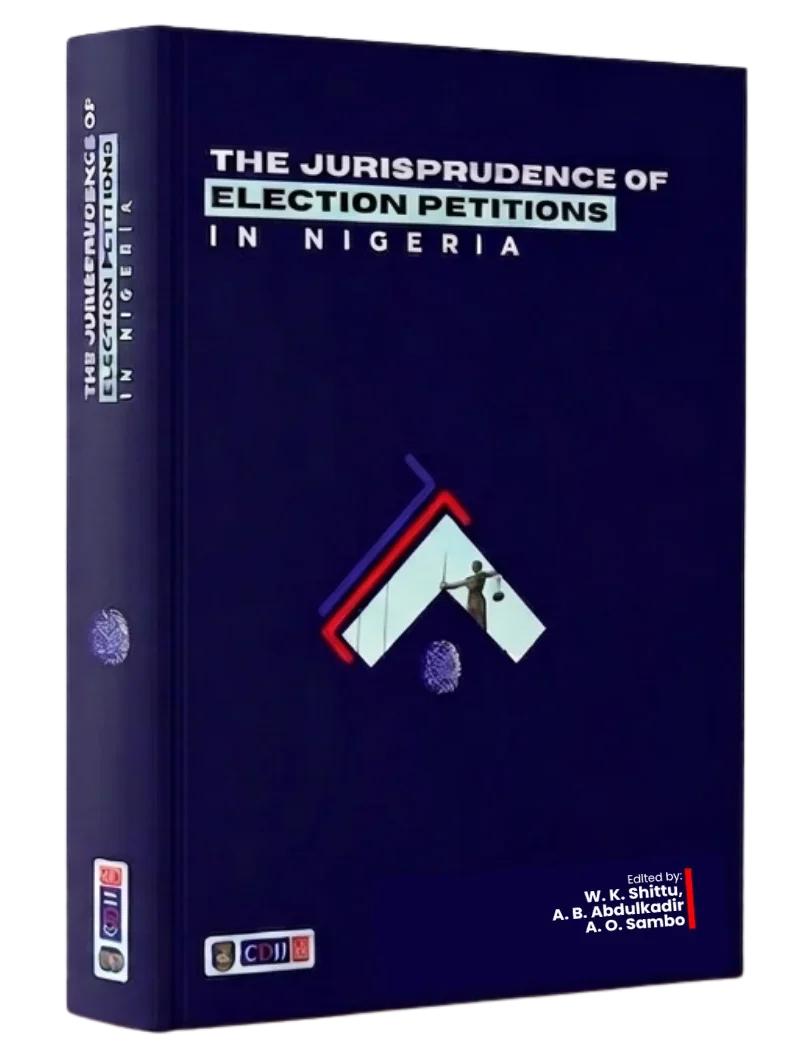
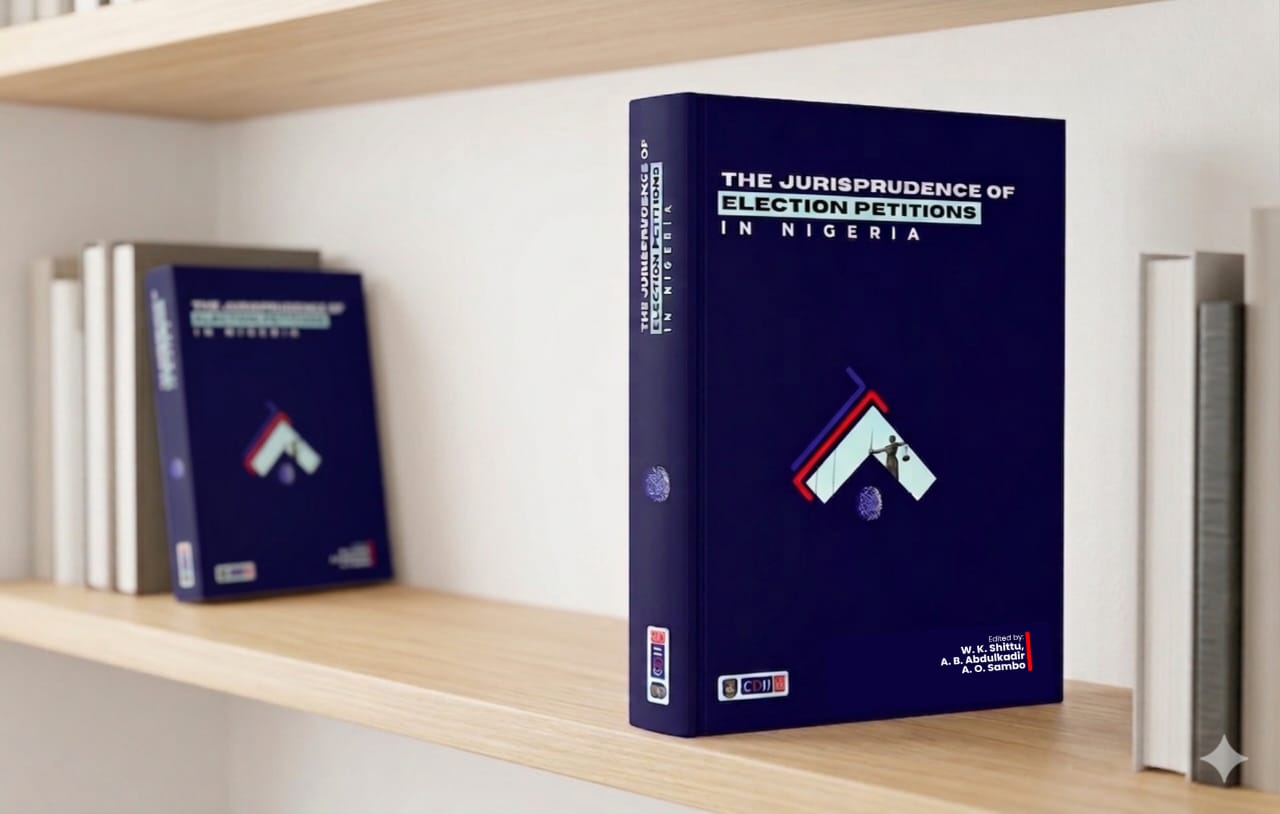
Elections play fundamental roles in constitutional democracy. It is regarded as the lifeblood of democracy because it provides the fundamental mechanism through which citizens choose their leaders, hold them accountable, and ensure the peaceful transfer of power, while also conferring legitimacy on governments and reflecting the popular will of the people. Thus, this book titled “The Jurisprudence of Election Petitions in Nigeria catalyses academic discourse on electoral disputes settlement mechanisms in Nigeria’s constitutional democracy. The surge in election petitions mirrors the judicialisation of electoral disputes in the democratic processes in Nigeria. Since the fourth Republic, the courts, particularly the Apex Court, have developed an extensive and complex body of jurisprudence that shapes the contours of electoral justice. All these took centre stage in this book.
ABOUT THE EDITORS
Wahab Kunle Shittu, SAN, Ph.D. is a distinguished figure in the Nigerian legal landscape, embodying a rare combination of academic depth and practical legal expertise. He earned his LL.B from the University of Lagos in 1986 with Second Class Upper Division honors, sweeping multiple academic prizes including the Prince Bola Ajibola Prize and the Dean’s Prize for the most outstanding student. His postgraduate pursuits further solidified his intellectual standing, culminating in a Master of Laws (LL.M) with distinction from the University of Lagos and a Doctor of Philosophy (Ph.D.) from the University of Ilorin. Since 2005, Dr. Shittu has significantly influenced legal education as a Lecturer in the Department of Jurisprudence and International Law at the University of Lagos. His teaching spans critical areas such as the Nigerian Legal System, Public International Law, and Islamic Law.
Abdulkadir Bolaji Abdulkadir is a Professor and a former Head of Department in the Department of Public Law, Faculty of Law, University of Ilorin, Ilorin, Nigeria. He specialises in Environmental law, Solid Minerals Law, Environmental Health Law and Human Rights Law. He has authored several articles in academic journals across the globe and has presented conference papers at local and international levels in these areas of law. He is the Secretary of the Board of Trustees and Director, Research, & Innovation of the Constitutional and Democratic Justice Initiative.
Abdulfatai Oladapo Sambo is a Professor and a former Head of Department in the Department of Public Law, Faculty of Law, University of Ilorin, Ilorin, Nigeria. He has successfully supervised at least Thirty (30) Master’s Degree students and 4 (Four) Ph.D. Students. He has acted as a resource person in many Workshops locally and internationally. He was also one of the resource persons who taught Public International Law at the training organised by the United Nations Environmental Programme (UNEP) for South Sudanese judges in Malaysia. He specialises in Constitutional Law and delivered the 278th Inaugural Lecture of the University of Ilorin on the 17th of April, 2025 titled: Judicialising Politics without Politicising the Judex. He is one of the editors of the book titled: Constitutionalism and Constitutional Adjudication in Nigeria.
PART ONE
THEORETICAL FRAMEWORK OF ELECTORAL ADJUDICATIONS
- Theories of Election Petition Adjudication in Nigeria
Prof. Ibrahim Imam & Rilwan F. Mahmoud
- Piercing Through the Merits and the Risks in Judicialising Electoral Disputes in Nigeria by Professor Abdulfatai Oladapo Sambo & ABDULAZIZ, Ruqayyah Olaide
PART TWO
LEGAL FRAMEWORK ON ELECTORAL JUSTICE AND LITIGATION
- A Critical Review of the Legal Framework Governing Candidate Mortality in Nigeria’s General Elections by Ademola Elufisoye Elubode, Olumide Ogidan & Ebenezer Fikayo Adeojo
- The Legal Issues of Electoral Integrity, Technology, and Voter Engagement in the Nigerian Elections and Electoral Processes in the 21st Century by Akinsola O. K, Agboke M.O, & Oduyebo T.O
- An Assessment of the Electoral Act 2022 As a Legal Framework for Curbing Electoral Malpractices and Enhancing Electoral Justice in Nigeria by Abdulkadir Bolaji Abdulkadir & Ali Aminu Muhammad
- Towards Strengthening the Capacity of the Economic and Financial Crimes Commission under the Electoral Act in the Prosecution of Electoral Offences and Election-Related Terrorism in Nigeria by Wahab Kunle Shittu, SAN
- Towards the Integration of Mediation into Nigeria’s Post-Election Dispute Resolution Framework by Bola Rasaq Gold, SAN & Abdulkareem Ademola Mashood
PART THREE
ELECTORAL JUSTICE AND DEMOCRATIC GOVERNANCE
- Racing Against Democracy, Time Limits, Procedural Rigidity and Access to Electoral Justice in Nigeria by Ooreoluwa O. Agbede
- Mainstream Judicial Review of Electoral Disputes and Its Implication for Constitutional Democracy in Nigeria by Onikosi, Ahmeed Adedeji Adeyemi, Jamiu Akolade & Sewankambo Hamza
- A Legal and Constitutional Appraisal of Electoral Violence, Election-Related Terrorism and Impacts on Democratic Consolidation in Nigeria by Wahab Kunle Shittu SAN
- The Jurisprudence of Election Petitions in Technicality and Substantive Justice and Implications on Nigeria’s Democracy by Francis Ekene Ikebundu
PART FOUR
JUDICIALISATION OF ELECTION DISPUTES
- The Judicialisation of Politics in Nigeria Through Electoral Disputes and Their Implications for Democratic Consolidation, 2015–2023 by Zekeri Momoh & Manasseh Namura Mai-Lafia
- A Comparative Analysis of Election Petition Jurisprudence in Nigeria and South Africa in Relation to Electoral Justice and Democratic Legitimacy by Prince Pius Imiera & Emmanuel Adaramola Opeyemi
- Between a Cinch and a Catch-22 in Procedural Efficiency, Statutory Deadlines, and the Quest for Substantive Justice in Nigerian Pre-Election Law By Oluwaseye Thompson Adeboye; Anthonia Ugowe, & Solomon O. Afolabi
- Justice on the Clock in Judicial Capacity, Time Constraints, and the Quality of Electoral Adjudication in Nigeria (1999–2023) by John Afolabi Ogedengbe & Ruth N. Fadipe
- The Impact of Conflicting Decisions of Courts on Election Disputes in Nigeria by Rasheedat Abimbola Hassan-Aribito & Ibrahim Imam
Appendix: Summary of Chapters
Index………………….
PREFACE AND ACKNOWLEDGMENTS
Taylor Swift once said,
It’s not enough to just want change … You have to go and make change by voting.”
This foregrounds the fundamental role of elections in democracy. In every democratic society, elections are regarded as the lifeblood of democracy because they provide the fundamental mechanism through which citizens choose their leaders, hold them accountable, and ensure the peaceful transfer of power, while also conferring legitimacy on governments and reflecting the popular will of the people. In Nigeria, where democratic governance has evolved through cycles of military interruption and civilian restoration, the integrity of elections has remained central to the legitimacy of public institutions and the stability of the state. Therefore, election serves as the cornerstone and the heartbeat of democracy in Nigeria. Thus, this book on The Jurisprudence of Election Petitions in Nigeria catalyses academic discussions on electoral governance and constitutional adjudication in Nigeria. The surge in election petitions mirrors the judicialization of democratic processes in Nigeria. People ventilate their electoral grievance by contesting the election results in Courts. Since the advent of the Fourth Republic in 1999, Nigeria’s superior courts particularly the Supreme Court of Nigeria and the Court of Appeal of Nigeria have developed an extensive and complex body of jurisprudence that shapes the contours of electoral justice. This body of law has not only defined procedural and evidentiary standards but has also profoundly influenced political behaviour, institutional accountability, and democratic consolidation.
This text is tactically and thoughtfully divided into 4 parts and organised into 16 chapters. The book x-rays a systemic and pragmatic approach to the emerging jurisprudence in election petition. The first part, Theoretical Framework of Electoral Adjudication, centers on resolving electoral disputes within the realm of jurisprudential and constitutional theory. It questions the philosophical backgrounds of electoral disputes, the standard justifications for judicial intervention in political disputes, and the dilemma of striking the balance between the scale of sovereignty and judicial oversight. By grounding electoral adjudication within democratic theory, the book demonstrates that election petitions are not mere technical contests over votes and forms, but constitutional dialogues about legitimacy, representation, and accountability. The second part, Legal Frameworks on Electoral Justice in Nigeria, provides an incisive analysis of the constitutional and statutory architecture governing elections. Anchored primarily on the Constitution of the Federal Republic of Nigeria 1999 and the Electoral Act 2022, this section carefully dissects jurisdictional provisions, grounds of petition, procedural timelines, evidentiary thresholds, and the powers of election tribunals. It illuminates how constitutional designs, legislative reform, and judicial interpretation interact to define the scope and limits of electoral justice in Nigeria. The third part, Electoral Justice and Democratic Consolidation, moves beyond black-letter law to examine the broader implications of election adjudication for democratic stability. In a polity where electoral outcomes are frequently contested, the judiciary serves as the ultimate arbiter of political legitimacy. The book critically assesses whether judicial interventions have strengthened public confidence in democratic institutions or inadvertently deepened political polarization. It engages with recurring themes such as substantial compliance, burden of proof, technological innovation in elections, and the tension between procedural technicality and substantive justice. The fourth and final part, Judicialisation of Election Disputes, addresses one of the most significant developments in Nigeria’s democratic journey, the increasing resort to courts as decisive arenas of political competition. The phenomenon of judicialisation raises important questions about the separation of powers, judicial independence, and the proper limits of adjudication in inherently political matters. By examining trends in post-election litigation and the expanding role of appellate courts, the author contributes meaningfully to the ongoing debates about whether Nigeria’s democracy is being strengthened or strained by the centrality of judicial pronouncements in electoral outcomes.
This book stands out in terms of its doctrinal depth and analytical clarity and even perspective. The book addresses debatable Judicial decisions with objectivity without being oblivious of the challenges that our courts face and the effects of their decisions on Nigerian democracy. The book synthesizes judicial authorities, statutory authorities and constitutional principles in a way that is accessible to practitioners, academics, judges, policymakers, and students alike. This is a digitalized political era where electoral processes are being digitalized, and virtual proceedings are increasingly evolving. Thus, this book is a socio-political salvation at the moment. It thoroughly x-rays the judicialisation of the electoral processes the possible reforms that are capable of strengthening electoral justice. Ultimately, The Jurisprudence of Election Petition in Nigeria is more than a legal treatise; it is a reflection on the health of Nigeria’s democracy. It reminds us that while elections are decided at the ballot, their legitimacy is often affirmed in the courtroom. The endurance of democratic governance depends not only on credible electoral administration but also on a judiciary capable of dispensing impartial, principled, and timely justice.
This book stands as a significant addition to the growing body of scholarship on electoral law and democratic governance in Nigeria. It will undoubtedly serve as a valuable resource for years to come and as an enduring reference in the continuing quest to deepen constitutionalism and democratic consolidation in Nigeria.
To our readers, this book would not have been possible without the kindness, contributions, encouragement, and support of many individuals whose efforts made its publication a reality. Our first and special appreciation goes to Wahab Kunle Shittu (SAN), whose intellectual and tremendous support made the publication of this book possible. Despite the demands of his busy private legal practice, he graciously devoted time to reviewing the manuscripts and offered several insightful and valuable suggestions that greatly enhanced the quality of this work. The Editors wish to express sincere appreciation to all the contributors who dedicated their time, knowledge, and expertise to the preparation of the chapters in this book. Their scholarly insights, commitment to research, and intellectual contributions have greatly enriched the quality and depth of this work. The successful completion of this book would not have been possible without their cooperation, patience, and willingness to share their ideas. The Editors are truly grateful for their valuable efforts and for the confidence they placed in this project. It is hoped that this collective work will contribute meaningfully to scholarship and serve as a useful resource for readers and researchers.
Finally, The Editors sincerely express their profound appreciation to the Institute of Legislative Studies, University of Ilorin, and the Constitutional and Democratic Justice Initiative for their invaluable collaboration in bringing this book on the Jurisprudence of Election Petition in Nigeria to fruition. Their institutional support, intellectual partnership, and commitment to advancing scholarship in electoral jurisprudence were instrumental to the successful completion of this project. The Editors acknowledge that this work would not have been possible without the cooperation, commitment, and shared vision of these institutions in promoting research, dialogue, and knowledge development within Nigeria’s democratic and legal framework. Their support remains deeply appreciated.
LIST OF CASES
Adegboyega Isiaka Oyetola & Ors. v. Independent National Electoral Commission (INEC) & Ors. (2023) 32 E-WRN / 08 (SC)
Adeleke Ademola Jackson Nurudeen v. Adegboyega Isiaka Oyetola & Ors. (2023-05) Legalpedia 26471 (SC)
Adeleke v. Oyetola & Ors. (2020) 6 NWLR (Pt. 1721)
Agbaje v Fashola (2008) JELR 57484 (CA)
Atiku Abubakar v. Independent National Electoral Commission (No. 2) [2023] 19 NWLR (Pt. 1917)
Attorney-General of the Federation v Atiku Abubakar (2007) 10 NWLR (Pt. 1041) 1.
Awolowo v. Shagari & Ors. (1979) SC.62/1979
Bewaji v. Obasanjo (2009) 9 NWLR (Pt. 1093) 439
Clement v Iwuanyanwu (1989) 3 NWLR (Pt. 107) 39.
Dapialong v Dariye (2007) 8 NWLR (Pt. 1036) 332.
Eze v Governor of Abia State (2014) 14 NWLR (Pt. 1426) 192.
Fayemi v Oni (2010) 48 E-WRN / 02 (CA).
Governor of Ekiti State v Olubunmi & Ors (2017) 3 NWLR (Pt. 1551) 1.
Governor of Plateau State v Goyol & Ors (2007) 16 NWLR (Pt. 1059) 57.
GTB v Abiodun (2017) 9 NWLR (Pt. 1570) 185.
Ibikunle Amosun v Gbenga Daniel (2009) 04 E-WRN / 32 (CA).
Ibori v. Ogboru (2005) 6 NWLR (Pt. 920) 102
In Re – Madaki (1996) NWLR (Pt. 459) 153
Inakoju v Adeleke (2007) 4 NWLR (Pt. 1025) 423.
Muhammadu Buhari v. Independent National Electoral Commission & 4 Ors. (2008) 1 All N.L.R. 159
Rabiu v. Kano State (1980) 8–11 SC 130
Rauf Aregbesola v Olagunsoye Oyinlola (2011) 01 E-WRN / 33 (CA).
Stanbic IBTC Bank Plc v Udeuma (2014) 2 NWLR (Pt. 1392) 506.
Wike v. Peterside & Ors. [2016] NGSC 87
LIST OF STATUTES
Administration of Criminal Justice Act, 2015
Constitution of the Federal Republic of Nigeria, 1999 (as amended)
Court of Appeal Act, 2004
Criminal Code Act, 2004
Electoral Act, 2022
Evidence Act, 2011
Federal High Court Act, 2004
Freedom of Information Act, 2011
Independent National Electoral Commission (Establishment) Act, 1998
Interpretation Act, 2004
National Assembly (Powers and Privileges) Act, 2017
Oath Act 2004.
Penal Code Act, 2004
Political Parties (Registration, Regulation, etc.) Act, 2002
Public Officers Protection Act, 2004
Supreme Court Act, 2004
Jointly Published By:
Institute for Legislative Studies, University of Ilorin, Ilorin, Nigeria &
Constitutional and Democratic Justice Initiative (CDJI-Nigeria)
©2026, Constitutional and Democratic Justice Initiative (CDJI-Nigeria)
additional information
get free shipping
Finibus em ligula suscipit
huge discounts
Ante scelerisque lacinia
products Support
Finibus em ligula suscipit
flexible payments
Ante scelerisque lacinia